First: which city is your lot in?
The free X-ray shows each parcel's jurisdiction next to its folio, and the Lot Check reads that jurisdiction's official record and cites it.
Go by the folio, not the mailing address. The first two digits of a Miami-Dade folio number are the municipal code: 01 is the City of Miami, 03 Coral Gables, 06 North Miami and 11 Miami Shores, and 30 means unincorporated Miami-Dade, outside any city. Source: Miami-Dade Property Appraiser, Folio Numbers.
Florida does not require counties or cities to allow ADUs: each one decides. State law says a county or city "may adopt an ordinance to allow accessory dwelling units in any area zoned for single-family residential use". SB 48, a 2026 bill that would have required local governments to adopt one by a set date, passed the Senate on 4 February 2026 and died in the House on 13 March 2026. Sources: Florida Statutes (2026), s. 163.31771(3); SB 48 (2026), bill history.
For each place below, these are the questions to answer before you plan an ADU:
- Is an ADU allowed, and in which zoning districts?
- The minimum lot size, and the ADU's size limit.
- Setbacks, height and lot coverage.
- Parking.
- Who may live in it, and whether the owner must live on the lot.
- Whether it may be rented, long or short term.
- Separate meters and address.
City of Miami
The City's zoning code is Miami 21, amended for ADUs in 2025 (Ordinance 14375). An ADU is allowed by right on a lot with a single-family house in the T3-L, T3-O, T4, T5 and T6 zones. T3-R is not on the list.
- Size: at least 275 sq ft for an efficiency and 450 sq ft for one bedroom. A detached ADU may be up to 10% of the lot area and no more than 800 sq ft; one inside or attached to the house, up to 10% of the lot area and 500 sq ft. No waiver applies to the maximum.
- Placement: inside the house or in an ancillary building. In T3, an ancillary building sits at least 20 ft from the front, 10 ft from a side street and 5 ft from the side and rear lot lines, has at most two stories and 25 ft (one story in T3-R), and may not be taller than the house. T3 lot coverage is at most 50% on the first floor.
- Parking: in T3, one space per ADU, and none within a TOD or Transit Corridor.
- Ownership: the house and the ADU stay under the same ownership.
- Renting: an ADU may be rented only if the property has current proof of homestead status, and it must be used as predominately permanent housing. To rent it you need the building permit with a notarized ADU owner disclosure statement, a certificate of occupancy and an ADU registration certificate, renewed every year with proof of homestead and an inspection. Fees: $300 for the first registration and inspection, $250 for each annual renewal, $75 for a re-inspection. The registration can be revoked if the ADU is rented as transient or temporary lodging.
Sources: Miami 21, Section 3.18, Article 4, Table 3 and Table 4 (T3), Article 5, Illustration 5.3, Article 6, Table 13; City of Miami Code, s. 2-214.
North Miami
North Miami allows one detached ADU per house, only in the R-1 and R-2 districts, through the Development Review Committee's site plan review.
- Lot: at least 12,500 sq ft, and not served by a septic system.
- Size: at least 500 sq ft, and no more than 25% of the size of the main house.
- Height and setbacks: the same as for the main house. An ADU at the rear that is not visible from the street may, with screening, sit 10 ft from the rear property line.
- Parking: one space for the ADU, and the whole property must meet the city's parking requirements.
- Who lives there: the owner must live on the lot, in either the house or the ADU. A deed restriction limits the ADU to seniors (55 and over) or to people with extremely low to moderate incomes, and it may not be sold separately. No more than two people may live in the ADU.
- Renting: no lease shorter than six months. A rented ADU needs a certificate of use and a business tax receipt, both kept up every year, and the owner files an annual affidavit.
- Utilities: separate water and sewer connections are not required if the house's lines can be extended. Separate connections, if you ask for them, are at your cost.
- The city mails notice of the application to the abutting owners.
Source: North Miami Code of Ordinances, Chapter 29 (Land Development Regulations), s. 5-102, and s. 5-1402 for parking.
Miami Shores
Miami Shores does not allow ADUs. In its residential districts the permitted use is one-family dwellings, "but not more than one dwelling on any one plot", and the zoning code lists guest houses, accessory dwellings, and kitchens or bedrooms in accessory structures as uses that are not included. Using an accessory building as a dwelling of any type is a prohibited use. The draft rewrite of the residential rules that the Village published in July 2026 keeps these exclusions.
Sources: Miami Shores Village Code, Appendix A (Zoning), s. 411 and s. 501(13); draft R-district ordinance, July 2026.
Coral Gables
Coral Gables allows no rentable ADU. Its zoning code allows two kinds of accessory living space:
- An accessory dwelling above a garage, in a single-family (SFR) district, for members of the family living in the house or people employed on the premises, and without a kitchen.
- A guesthouse, only on a Residential Estate: a site of at least 1½ acres, 200 ft wide and 250 ft deep, with a house of at least 4,273 sq ft. The guesthouse may have a kitchen, may be up to 600 sq ft of ground area or 10% of the main building's ground area, whichever is greater, and stands in the rear yard. Only non-paying personal guests may stay in it, no guest year-round, and the owner may not live in it and rent the main house.
Design review: the Board of Architects reviews building permits against the code's architectural design standards. New buildings must be designed in a specific architectural style, such as Colonial, Venetian, Mediterranean, Italian, French or Bahamian, with the exceptions the code lists.
Sources: Coral Gables Zoning Code, s. 3-302, s. 3-305, s. 5-103 and s. 14-103.1, and "Residential estate" in Article 16.
Unincorporated Miami-Dade
On land outside any city, Miami-Dade County allows one accessory unit on a lot with a single-family house, inside the Urban Development Boundary, in the AU, EU and RU zoning districts (and GU land trended to them). The accessory unit is either an ADU, which may be rented, or a guesthouse, which is only for the household of the main house and may not be rented.
- Lot and size: the County's master plan sets 400 to 800 sq ft of habitable area for an ADU, on single-family lots of at least 7,500 sq ft.
- Placement and height: a detached ADU may not stand in front of the house or closer to the front lot line than the house, and may not be taller than the house. A one-story detached ADU follows the setbacks and lot coverage for accessory structures in its district. In RU-1, an accessory building sits at least 75 ft from the front and 5 ft from the rear, with the same interior side setback as the house: 10% of the lot width, at least 5 ft and at most 7½ ft. RU-1 lot coverage is at most 40% in newer subdivisions (lots at least 75 ft wide and 7,500 sq ft) and 35% in older ones (50 ft and 5,000 sq ft). Adjustments to an ADU's setbacks, height and lot coverage may be approved through the County's administrative adjustment procedure.
- Parking: one space on top of the house's, not required within 660 ft of a major corridor served by transit, a mixed-use corridor or a rapid transit activity corridor in the County's master plan.
- Who lives there: up to two people per bedroom overnight, children under three not counted. The owner does not have to live on the lot; an owner who does must live in the main house, not the ADU. The ADU may not be sold separately from the house.
- Renting: an ADU may be rented for periods of at least one month. It may not be a vacation rental on its own; the house and the ADU together may be one vacation rental.
- Meters and address: an ADU may have its own utility meters, address or unit number and mailbox. A guesthouse may not.
- Certificate of use: required for every accessory unit and obtained only by the owner of the house. An ADU's is renewed every year, with an inspection.
Sources: Miami-Dade County Code, s. 33-22, s. 33-28, s. 33-49 and s. 33-50; CDMP Land Use Element; Miami-Dade RER, Accessory Dwelling Units or Guesthouses.
At a glance
| Place | ADU allowed? | Minimum lot | Size limit | May it be rented? |
|---|---|---|---|---|
| City of Miami | Yes, by right in T3-L, T3-O and T4 to T6; not in T3-R | No ADU minimum; the size cap is 10% of the lot area | Detached up to 800 sq ft, attached up to 500 sq ft, and within 10% of the lot area | Yes, as predominately permanent housing, on a homestead property, with an annual registration |
| North Miami | Yes, one detached ADU in R-1 and R-2, by site plan review | 12,500 sq ft | 500 sq ft up to 25% of the size of the house | Leases of six months or more, to seniors or income-qualified tenants; the owner lives on the lot |
| Miami Shores | No | — | — | — |
| Coral Gables | Only quarters above a garage, without a kitchen; a guesthouse only on a Residential Estate | Residential Estate: 1½ acres | Guesthouse: 600 sq ft or 10% of the main building's ground area, whichever is greater | No |
| Unincorporated Miami-Dade | Yes, in AU, EU and RU inside the Urban Development Boundary | 7,500 sq ft | 400 to 800 sq ft | Yes, for a month or more; not as a vacation rental on its own |
Will the Casita ADU fit?
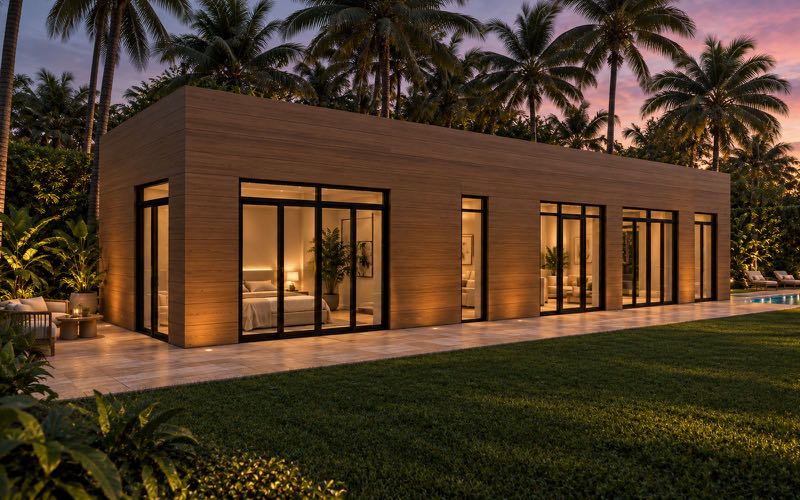
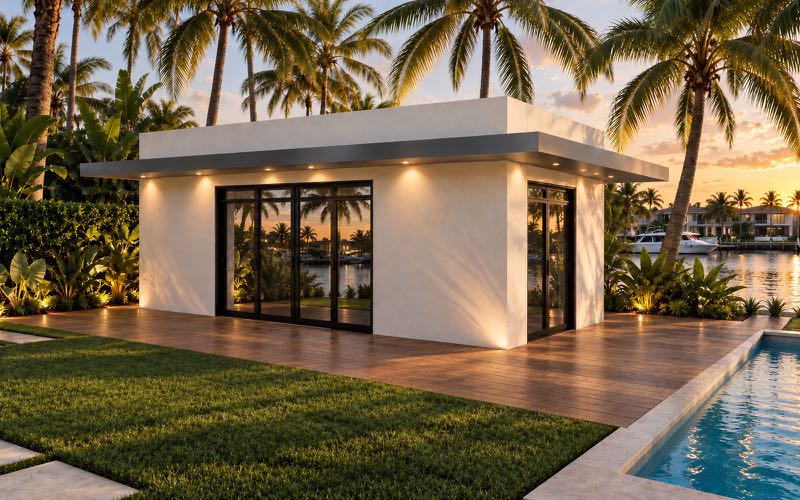
The Casita ADU is about 30 × 13 ft, 400 sq ft gross and 10 ft high: one bedroom, a bathroom and a kitchen and living room. The Lot Check shows what your parcel allows and which module fits.
Its Florida DBPR filing is in preparation. If the State of Florida does not approve the unit, the deposit is refunded in full within 48 hours.